Sunday, 9 August 2015

MEASURES OF DISPERSION- INTERQUARTILE RANGE AND QUARTILE DEVIATION

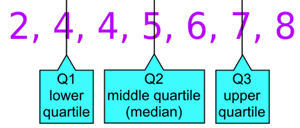
The interquartile range (IQR) is a measure of variability, based on dividing a data set into quartiles. Quartiles divide a rank-ordered data set into four equal parts. The values that divide each part are called the first, second, and third quartiles; and they are denoted by Q1, Q2, and Q3, respectively.

  1. The "Interquartile Range" is from Q1 to Q3:
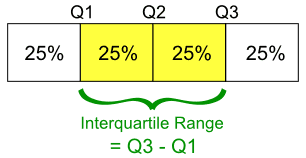
    Interquartile Range


Example 1

Quartiles
The Interquartile Range is:
Q3 - Q1 = 8 - 4 = 4


EXAMPLE 2


EXAMPLE 3:

Data set in a table

ix[i]Quartile
1102
2104
3105Q1
4107
5108
6109Q2
(median)
7110
8112
9115Q3
10116
11118
For the data in this table the interquartile range is IQR = 115 − 105 = 10.

Example 4:

The wheat production (in Kg) of 20 acres is given as: 1120, 1240, 1320, 1040, 1080, 1200, 1440, 1360, 1680, 1730, 1785, 1342, 1960, 1880, 1755, 1720, 1600, 1470, 1750, and 1885. Find the quartile devi ation.

Solution:
After arranging the observations in ascending order, we get
1040, 1080, 1120, 1200, 1240, 1320, 1342, 1360, 1440, 1470, 1600, 1680, 1720, 1730, 1750, 1755, 1785, 1880, 1885, 1960.
            Q1=Value of (n+14)th item
                  =Value of (20+14)th item
                  =Value of (5.25)th item
                  =5th item+0.25(6th item−5th item)=1240+0.25(1320−1240)
            Q1=1240+20=1260
            Q3=Value of 3(n + 1)4th item
                  =Value of 3(20 + 1)4th item
                  =Value of (15.75)th item
                  =15th item+0.75(16th item−15th item)=1750+0.75(1755−1750)
            Q3=1750+3.75=1753.75


Q.D=Q3−Q12=1753.75−12602=492.752=246.875

Example 5:
Calculate the quartile deviation from the data given below:
Maximum Load
(short-tons)
Number of Cables
9.3−9.7
2
9.8−10.2
5
10.3−10.7
12
10.8−11.2
17
11.3−11.7
14
11.8−12.2
6
12.3−12.7
3
12.8−13.2
1
Solution:
The necessary calculations are given below:
Maximum Load
(short-tons)
Number of Cables
(f)
Class
Boundaries
Cumulative
Frequencies
9.3−9.7
2
9.25−9.75
2
9.8−10.2
5
9.75−10.25
2+3=7
10.3−10.7
12
10.25−10.75
7+12=19
10.8−11.2
17
10.75−11.25
19+17=36
11.3−11.7
14
11.25−11.75
36+14=50
11.8−12.2
6
11.75−12.25
50+6=56
12.3−12.7
3
12.25−12.75
56+3=59
12.8−13.2
1
12.75−13.25
59+1=60
            Q1=Value of (n4)th item =Value of (604)th item = 15th item
            Q1 lies in the class 10.25−10.75
            ∴     Q1=l+hf(n4−c)
            Where l=10.25, h=0.5, f=12, n/4=15 and c=7
            ∴     Q1=10.25+0.512(15−7)=10.25+0.33=10.58
            Q3=Value of (3n4)th item =Value of (3×604)th item = 45th item
            Q3 lies in the class 11.25−11.75
            ∴     Q3=l+hf(3n4−c)
            Where l=11.25, h=0.5, f=14, 3n/4=45 and c=36
            ∴     Q1=11.25+0.514(45−36)=11.25+0.32=11.57


Q.D=Q3−Q12=11.57−10.582=0.992=0.495

References:
Math is fun
Wikipedia
www.emathzone.com